Climate Action Plan | 2024 emissions
Travalyst exists to catalyse positive change across the travel and tourism industry and, in line with our own mission, we recognise the role we ourselves must play in proactively addressing the climate crisis.
Why do we have a Climate Action Plan?
In 2021, we committed to reducing our carbon emissions to net zero by 2030. Climate change is a global challenge, and every organisation has a role to play in the effort to limit its impact. By reducing emissions, we can help to mitigate the effects of climate change. Actions to combat climate change can help to address environmental and social issues, contributing to the overall health and safety of communities across the world, and help preserve important biodiversity which is increasingly under threat from rising temperatures.
In order to achieve the Paris Agreement’s objective of limiting global warming to no more than 1.5°C above pre-industrial levels, and keeping in mind the world’s current climate policies are projected to result in around 2.7°C warming, it is crucial that we act now.
The travel and tourism industry generates around 10% of global GDP and supports 357 million jobs worldwide, yet it is responsible for roughly 9% of total global carbon emissions. As climate change drives more severe weather events, wildfires, and rising sea levels, the industry faces mounting risks. Addressing its climate impact is not only essential for the planet—it is critical to safeguarding its own economic future.
As one of the founding signatories of the Glasgow Declaration for Climate Action in Tourism, we understand what the tourism industry can, and must do. This is why Travalyst is working together with stakeholders from across the industry, to rethink the way we travel and operate with a goal of ensuring that there is a thriving future for generations to come.
We recognise that the carbon footprint of our operations is comparatively small for the sector. That said, as the unifying organisation behind a powerful coalition of leading travel and technology brands, we are in a unique position to set an example to the industry and we welcome this opportunity.
Our climate action plan articulates our own commitments to reduce our carbon footprint, the environmental impact of our day-to-day decisions and transparently outlines the challenges and opportunities we encounter on our path to achieving net zero emissions.
What do we mean by net zero emissions?
Essentially, aiming for net zero means to try to reduce carbon emissions as much as possible, then invest in projects that either prevent emissions elsewhere or pull carbon out of the air to reach a “net-zero” balance on paper.
Net zero, as defined by the Science Based Targets initiative (SBTi) in the context of corporate global targets, means halving emissions in the mid-term (by 2030) and then a 90% emissions reduction in the long term (2050), with the remaining 10% being captured into carbon removal and storage.
As signatories of the Glasgow Declaration for Climate Action in Tourism we have committed to achieving net zero emissions as soon as possible by 2050, but by ambition, we have brought this forward to 2030.
Our Commitment
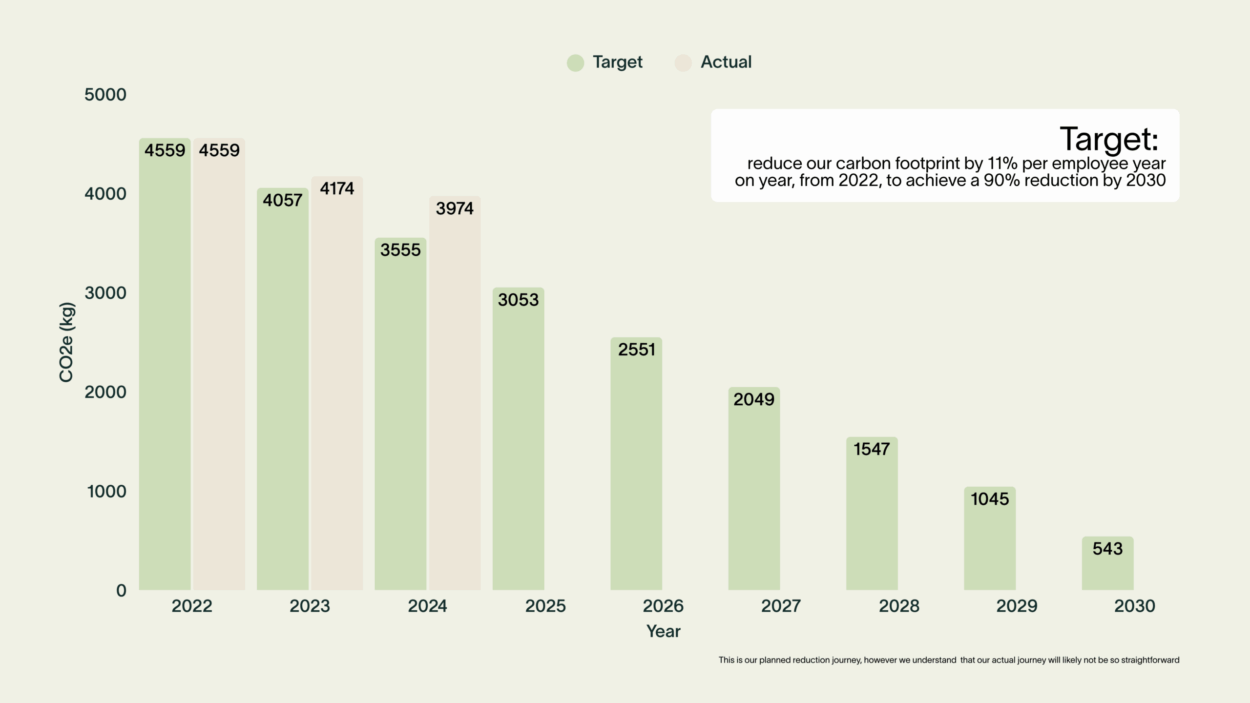
Measuring and abating our carbon footprint since our inception and using 2022 as our base year, we committed to reducing our emissions each year by at least 11% per employee, to achieve net zero by 2030.
Setting our base year
In order to reduce our footprint and reach net zero by 2030, we must set a baseline year from which we track our annual progress.
As Travalyst was founded in September 2019, a significant portion of our initial emission-related operations and team growth were impacted by COVID-19. This disruption largely covered 2020 and 2021, making these years unsuitable as base years, a view supported by guidance from the SBTi and the Glasgow Declaration. Consequently, we consider 2022 to be the most appropriate baseline year, as it reflects our first “normal” year of operations since our inception.
Our carbon intensity metric
We are tracking our progress against an intensity metric. This means measuring how much CO2 is emitted for one unit of business output, or per specific activity such as per product sold or per unit of revenue. In our case, as a small organisation with only scope 3 emissions (more detail below), we measure our emissions “per employee”. This allows us to consistently monitor our emissions, analyse trends and identify areas of inefficiency. For more information about carbon intensity metrics, visit ecollective’s blog post.
In the future, we plan to incorporate other intensity metrics that would better reflect the impact we aim to drive as an organisation. This way, we can ensure that every kilogram of CO2 we emit serves a greater purpose and brings us closer to our goal of making travel a force for good.
To achieve net zero by 2030, we are taking the following steps:
- Measuring and monitoring:
Supported by ecollective, we have designed a framework that measures our footprint as accurately as we can. We account for emissions across scopes 1, 2 and 3 as per the latest guidance from the Greenhouse Gas (GHG) Protocol and the SBTi. However, as a fully remote organisation with few physical assets, we have zero scope 1 and 2 emissions and we intend to stay this way regardless of growth. Unless something changes, we therefore need only to manage scope 3 emissions. - Setting our target:
In line with the SBTi guidance, we have set an ambitious annual emissions reduction target, aligning it with the global corporate standard required to limit global temperatures to a 1.5°C increase. For any of the remaining emissions, we compensate for them by investing the same amount in carbon abatement projects (see below). - Delivering on a meaningful action plan:
To achieve our targets, we have aligned with SBTi guidance to implement an abatement and offsetting plan which prioritises the avoidance and reduction of emissions.
This plan is defined by four pillars:
a) Avoid: We have developed a carbon reduction strategy which identifies areas in which Travalyst can reduce emissions or avoid them completely. For example, Travalyst operates a work-from-home structure, so we avoid emissions associated with operating our own office.
b) Reduce: For activities where emissions cannot be avoided, we find ways to reduce the impact. For instance, we invest in Sustainable Aviation Fuels (SAF) through our collaboration with Neste (see here for more information on SAF) to reduce our scope 3 emissions. Neste makes sure that the SAF we purchase provides additional GHG emission reduction rather than being used for regulatory schemes like mandates. We also prioritise running virtual events over in-person events wherever possible, and prioritise train travel to reduce flying wherever possible.
c) Restore: Along with the efforts we can take internally to improve our practices, we recognise the role that Travalyst must play in supporting measures taken to restore and protect vital ecosystems. Travalyst’s mission is to ensure that tourism has a regenerative, positive impact on people and places: unlocking the industry’s potential as a major contributor to a healthy and resilient planet. Travalyst brings together a global coalition of leading travel and tourism service providers aiming to deliver unified sustainability reporting; making it easier for travellers and travel providers to make better choices – for themselves and the planet.
d) Compensate: As a last resort, we compensate for any unavoidable emissions through a mixture of carefully selected carbon removals following guidance from the Oxford Principles for Net Zero Aligned Carbon Offsetting. To truly achieve net zero, we know that carbon offsetting should be implemented sparingly, if at all, and only through high-quality and durable projects to neutralise remaining emissions. We know that not all carbon offset schemes are created equal, which is why we work closely with Klimate on a portfolio of nature-based and technological solutions that are verifiable and correctly accounted for, have a low risk of non-additionality, reversal, and creating negative unintended consequences. We actively look for projects that have both environmental and social sustainability co-benefits globally. For instance, we support carbon storage and capture projects which help regenerate soils, reduce nutrient leaching and fertilise crops naturally. See below some of the vital restoration projects that we support through our collaboration with Klimate. - Aligning efforts and advocating for a just and fast transition to net zero:
Climate change requires a coordinated approach to achieve the accelerated pace and scale necessary to tackle its consequences. We have aligned with industry-leading and global efforts, such as becoming a launch partner and founding signatory of the Glasgow Declaration for Climate Action in Tourism with the aim to hold ourselves accountable and champion consistent messaging, targets and approaches. - Transparency as standard:
The journey to net zero is rarely linear, so above all we aim to normalise transparency. We hope to not only motivate other organisations to communicate their climate action progress candidly, but also to give clarity on the roadmap for other organisations to follow. We can only achieve sustainability by working together; sharing our learnings and our challenges as well as the wins.
Our Footprint
We are working with ecollective to measure and reduce our carbon footprint. By calculating our emissions, we can strive to lower them each year until we achieve our net zero emissions goal.
By making small but effective changes, we can reduce the carbon emitted per employee each year in a practical way that complements our business operations.
How big is our footprint?
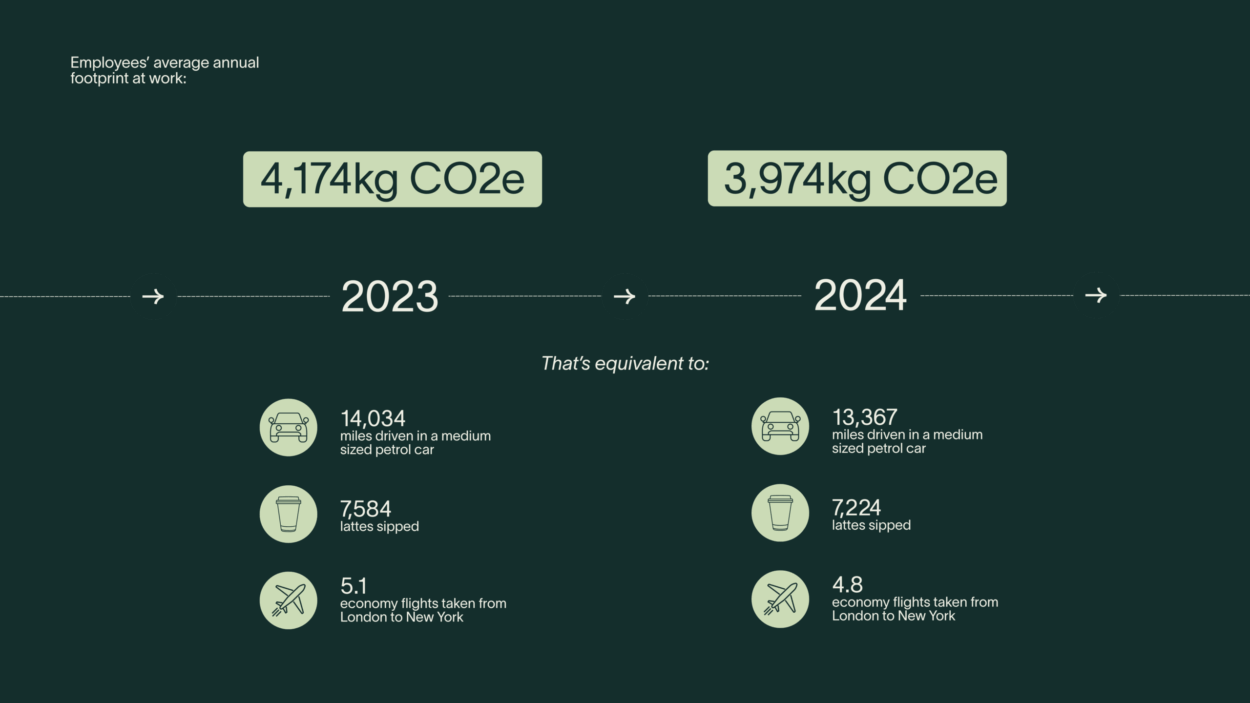
Our targets

What our footprint is made up of
The core Travalyst team is small and remote-working, however as we are based internationally (currently in the UK, the USA, mainland Europe, India and South Africa) as well as working with travel and technology companies from across the globe, taking a flight to a business related event is often the only viable option. Our company policy mandates that we always travel in economy (because travelling in premium economy or business class leaves a larger carbon footprint) but flights are still a large part of our emissions.

What’s next?
We are working with Neste and Klimate on our carbon abatement and removal portfolio for the footprint we do have each year. We are learning and developing our approach as we go, meaning that we abate by a variety of methods at present (see below for more details).
As we learn more about our footprint and where the majority of our emissions come from year on year, we intend to develop reduction processes across our abatement portfolio that are responsive to the impact and type of emissions we generate. As is clear, flights generate a large proportion of our footprint and as such, alongside investment in Sustainable Aviation Fuels, we’ll be working internally and with industry experts on the most impactful way to address this.
Accountability
Our approach
Calculating our own carbon footprint can be a little complex, as almost everything we do has a footprint. To make sure we do it right, we partnered with ecollective to help us measure and improve our carbon footprint. Their calculations have been peer-reviewed by industry and are based on the latest data. This data is updated annually in order to improve accuracy over time.
We have adhered to the Greenhouse Gas Protocol (GHG Protocol) and applied emission factors provided by DEFRA and other data sources. The areas in scope for this study include:
- Office (work from home) emissions
- Staff business travel (including any accommodation used)
- Website
- Virtual events
- Hosted in-person events
- Staff commuting
- Consultants
- Purchased Goods
Carbon calculations are never perfect but our aim is to make the measurements and our abatement plan better each year. As new guidelines, protocols and better data are developed, we will revise our measurement framework, targets and abatement plan to ensure our climate action plan remains ambitious and up-to-date. To keep ourselves accountable and open to critique, we are happy to share our methodology. Reach out to [email protected] or to ecollective to find out more.